Monday, June 19, 2017

A Birthday Cake, a Preacher, and God's Will


Is it possible to know what God’s will is for your life?

Countless numbers of people over the years have struggled with the question of knowing what God’s will is for them. I have wrestled with this question myself over the years and have prayed that God would reveal his will to me. But quite frankly there have been those times when I just didn’t know for sure what God’s will was for my life.

But what if we were to reframe the question and instead of asking whether we can “know” God’s will we might ask how can we “do” God’s will? Now this is a whole different matter, isn’t it?

When Jesus taught his disciples to pray he gave us a remarkable prayer known as the “Our Father” or the “Lord’s Prayer”. In this prayer one of the petitions he taught us to pray goes like this: 

“Thy kingdom come, thy will be done on earth as it is in heaven.” 

A paraphrased version of this petition is as follows:

“Help us do your will!”

For years I have been repeating the Lord’s Prayer in worship and I have read it more times than I can count. Then it occurred to me that Jesus wasn’t teaching us to pray so we might “know” God’s will but rather to pray that God would help us to “do” his will.

Reviewing some old sermons this past week I came across a wonderful story about one of the most progressive Evangelicals you will ever meet: Tony Campolo. I wish I had the space to tell you more about this wonderful man but I can tell you a story that will suffice to demonstrate what “doing” God’s will might look like.

Tony back in the day was a popular speaker at Christian conferences and gatherings. On one occasion he was invited to speak at a conference being held in Honolulu, Hawaii. 

Now Tony lives in Philadelphia so the time difference between the two time zones is significant. The first night in Honolulu Tony awoke at 2 am local time so he decided to go to the diner next to the hotel and get a cup of coffee and a doughnut.

As he was sipping his coffee a group of rather boisterous working ladies (prostitutes) entered the diner. Their language was pretty risqué so feeling uncomfortable Tony decided to leave. But then he heard one of the ladies say: “Tomorrow is my birthday!” One of her sidekicks sarcastically replied: “So what do you want me to do, throw you a party.” Tony said that he could tell the birthday girls was hurt by her friend’s sarcasm.

So after the ladies left Tony approached the manager behind the counter and asked about the group of ladies. He was told that the birthday girl’s name was Agnes and they came into the diner like clockwork each morning around 2:30. Tony then floated the idea by the manager of throwing a birthday party for Agnes.

The manager thought it was a great idea and offered to bake a cake for Agnes and put the word out on the street that there would be a birthday party at the diner the next morning.

So when the working ladies showed up at the diner, which was decorated with balloons and crepe paper, the place was full. They all began singing "Happy Birthday" to Agnes.

Agnes was so taken by the surprise party and especially the cake that she asked if she could run down the street to show it to her mother. She promised to be right back.

After she left Tony gathered everyone around him and said he wanted to pray for everyone. So he thanked God for loving these ladies when no one else seemed to love them, for watching over them, and for being there for them whoever they were in need.

When he finished the prayer the diner manager said: “I didn’t know you were a preacher. What kind of preacher are you anyway?” 

Tony replied: “The kind that would throw a birthday party for a prostitute.”


I don’t know about you but somehow I just think Tony was doing God’s will even if it looked unorthodox to some.

Sometimes just doing God’s will makes more sense than trying to know it.

Saturday, June 17, 2017

Have I Been Wrong About Jesus?


Just the other day I had this horrible thought:

What if I have been wrong all this time about Jesus’ nonviolent approach to life?

What if I have been wrong about nonviolence being the core meaning of his message?

What if I totally misunderstood his mission of nonviolence? 

What if I misunderstood that Jesus came to usher in the kingdom of his Father through nonviolent love rather than by violent force?

I then tried to imagine what Christianity might look like if in fact I have been wrong, that is in the way I interpret his message concerning the nonviolent power of the Gospel. 

Would we evolve (devolve) into a religion somewhat similar to radical Islamists?

If I am wrong about Jesus’ penchant for nonviolence then what would the church look like? Would it become an exclusive social club reserved for members determined to protect themselves on Sunday morning by their own might?

Could I be so wrong in believing that the power of the Gospel was actually fueled by nonviolence? 

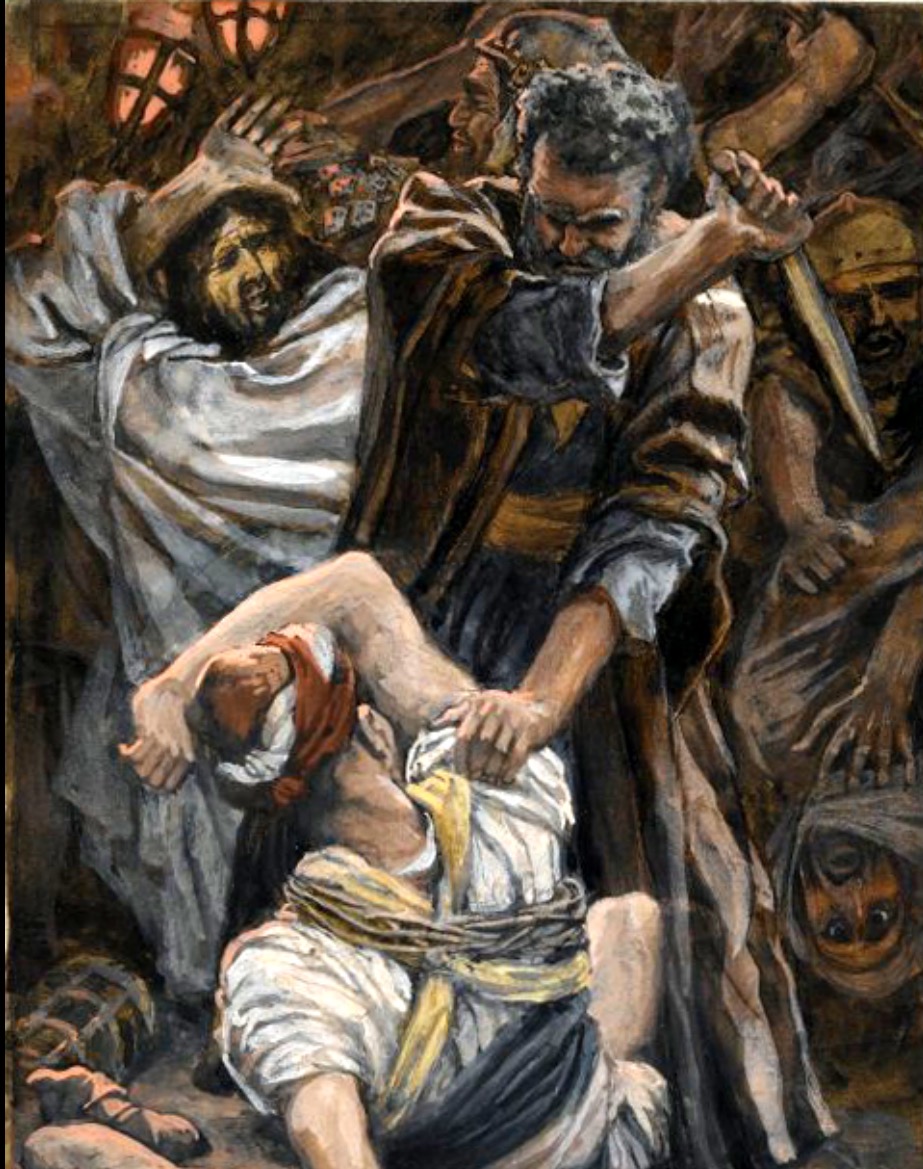
There is a story told in all four Gospels of Jesus being arrested in the garden. The time of his crucifixion was drawing near and he was with his disciples praying in the garden when soldiers, temple police, and others bearing arms came to arrest him.

This was one of those dangerously explosive moments in Jesus’ life that would have tempted the best of us to respond with our own form of violence. Well, one did. Peter was carrying a sword and when the attempt was made to apprehend Jesus he drew his sword and cut off the ear of Malchus (a slave of the High Priest). 

So Jesus responded by healing the severed ear and saying: 

“Put your sword away for the sword will only lead  to your death.” Okay, I paraphrased the verse. 

This was Jesus’ response to the threat of violence used against him and his disciples. As we all know he was soon thereafter executed on the cross.

As I reviewed this story in all four Gospels I concluded that I had not been wrong about Jesus’ use of nonviolence in a incurably violent world. The world has always been a dangerously violent place in which to live. There seems to be a streak of violence lying just beneath the surface of all of us.

What would it take to spark such violence within us? Yes Evil is real. It is dangerous. It is life-threatening. It is bent on having its way by turning humans into violent perpetrators of its will. Indeed many have become convinced that violence is our only option in response to violence. I can understand this but I do not believe this would have been Jesus' approach.

Perhaps the Apostle Paul hit the nail square on the head when he wrote to the Christians at Ephesus:

“For our struggle is not against enemies of blood and flesh, but against the rulers, against the authorities, against the cosmic powers of this present darkness, against the spiritual forces of evil in the heavenly places”

No I do not think I have gotten Jesus wrong after all. I do not believe that I have misread the Gospels portrait of a nonviolent and all loving Messiah who came to start an upside down revolution called the “kingdom of God!” 

A nonviolent kingdom in which the self-sacrificial love of Christ serves as our mandate to perpetuate Jesus’ original mission.

Perhaps this is what faith is really all about, not so much as a means to get us into a postmortem heaven,  but rather to live according to the values of God’s kingdom on earth in real time.

Just maybe of course this is what lies behind the prayer petition Jesus taught us to pray:

“Thy will be done, on earth as it is in heaven.”

No, I don’t believe I have been wrong about Jesus’ nonviolent mission to usher in God’s kingdom on earth. More importantly we all share in this mission of nonviolence.

Thank God!

Monday, June 12, 2017


Getting old ain’t for sissies . . . but it ain’t that bad either!

Yes, aging is challenging. The aches and pains, the persistent stiffness, the decrease in mental acuity and physical dexterity, and short term memory loss are all natural consequences of getting old. 

Due to this aging process I now have a doctor for every organ in my body (well almost every organ), not to mention an increase in the number of doctor appointments I must make during the year. They do intrude on my golfing.

Those of us who joke about growing old often laugh at the prospect of standing in front of our refrigerator's open door and wondering why the hell we opened it in the first place. 

Not too long ago my wife and I drove about thirty miles to a SAM’s and as we walked into the store we both looked at each other and burst out laughing: We had forgotten what we had come to buy! 

But in spite of all this I wouldn’t trade where I am now for all the tea in China. Really! There are actually some great benefits in belonging to the advanced aged club.

For example, I get to play golf from the“forward tees” now, seriously decreasing the overall length of the golf course. I also get to use my trusty foot wedge now and again without being overcome with guilt or shame. It’s what old guys do. Sometimes we refuse to hit out of bunkers too, but not always.

I’m just blessed to be out there on the course, hanging out with my other old fart buddies twice a week. We have a blast and don't care who knows it. We even have lunch together after each round.

The older I become the less concerned I am with impressing people. This says more about me than it does about them of course. Impressing my friends was a big deal back in the day, but quite frankly there is now little correlation between what others think of me and my own self-esteem. I like me now, so that’s good enough.

The older I become the more I appreciate the mysteries of life and death. In other words, I no longer need the answers to all the big questions in life.

Really, this is huge! There was a time when I believed having the right answers somehow made me a smarter person. Perhaps this is why I always felt like I had to have the last word in any argument or debate. I needed to prove that I was right (life was always about competing). This was important to me. It made me feel really intelligent when in fact it really demonstrated how dumb I was acting.

Not so much anymore. The older I become the easier it is for me to allow others to be ignorant or uninformed without my losing any sleep over it. That’s their issue, not mine.

Which brings me to another big benefit of growing older: I no longer believe I can change anyone (including my children). I can’t begin to tell you how much energy and time I have spent over the years trying to change other people. The frustration of trying to reshape another’s belief system or behavior patterns is just too overwhelming. 

What others believe or how they behave is their business. So have at it my friend, I’m not your judge—thank God! I’ve learned to let them be them. Life is so much easier this way.

Finally, as I have grown older God has grown bigger (In my own mind that is). 

Now please don't think I am suggesting that God grew larger simply because I grew older, as if there is some organic correlation between my getting older and his getting bigger. But in my mind he has become incredibly larger than life itself. 

I no longer feel the need to compress God into a set of rational doctrines (let alone freeze dry him there) or written confessions. God is mystery in a good way. He is mystery that escapes all human attempts to define him in human categories.

He is the ground of all being and in him I move and live and have my being. 

This is good enough. I can wait for fuller revelations in due time—that is when my aging process concludes and time no longer matters.

So, threescore and ten is not so bad after all! 

Yet even age is a relative thing; my 86 year old friend Bob keeps calling me “young man!” 

Life is good!

Saturday, June 10, 2017

The Way of the Cross


For I decided to know nothing among you except Jesus Christ, and him crucified.
                                 —The Apostle Paul

A good friend of mine and fellow pastor responded to my last post (“Who is Top Dog) by saying: “It is time for you to change tribes. You have indeed become an Anabaptist.” Well, he was only partially correct.

Anabaptists generally are separatists. Many of them do not participate in the political workings of whatever country they inhabit. The Amish are a well known example. Most Anabaptists are pacifists (Mennonites) and would register themselves as conscientious objectors during times of war (as would the Quakers).

I do not yet consider myself a separatist to this extreme. I do however, warm considerably to Anabaptist theology, especially regarding their resistance to violence and war and their penchant for obeying the call of Christ to follow him. Anabaptists place a very high premium on following Christ.

In this regard, I believe Anabaptist theology has a great deal to offer American Christianity today, especially its emphasis on a cross-centered approach to faith. In other words, the cross of Christ is for Anabaptists the very center of their faith.

They bring into sharp focus their views on violence, war, and obedience to Christ by focusing on what they believe to be the central theme of Christianity: The crucifixion of Christ. Some call this a “cruciform” approach to faith.

In fact, it is this cross that provides us an incredible opportunity for engaging the powers in our own time. Granted, for many the way of the cross is regarded as a sign of weakness and is foolishness (1 Corinthians 1:18) and according to Irishman Peter Rollins it is utterly “absurd”.

In his newest book, The Crucifixion of the Warrior God, theologian and pastor Gregory A Boyd points out: “While the early church generally embraced the foolishness of the cross, this became much more difficult once the church stopped being persecuted and embraced the power of the sword that Constantine offered it. ” The so-called “Constantinian synthesis”.

Yes the message of the cross does sound foolish and ineffective in our own time.

In fact, during Jesus’ day the Roman Empire was the big cat in charge, and how did Rome maintain peace: Through the use of crucifixion. Crosses literally littered the countryside of both Galilee and Judea with the corpses of those who opposed the powers or were considered a threat to Pax Romana.

The cross was one of the most horrific instruments of torture and death ever devised by humans to kill other humans. It was an insidiously inhumane and violent method of capital punishment.

But the cross nevertheless became the central and most enduring symbol of our Christian faith.

Ironically God used the cross to confront and subvert the powers that be in Jesus’ day. He became the crucified One who demonstrated that the only way the human cycle of violence could be broken is to respond to it in a nonviolent way. He demonstrated in his own wisdom that the most effective response to Evil is nonviolence and self-giving love.

This he did on Calvary! It doesn’t make sense. It is absurd. It is foolishness.

But it is the way of Christ!

You see, when our main focus of the cross is on personal salvation we naturally miss the broader meaning of Christ’s crucifixion. Yes Jesus died for our sins, according to the Scriptures.

But more broadly speaking the cross was God’s once-and-for-all answer to the problem of Evil and violence in this world. It was God’s way of saying: “It ends right here!” The old hymn “Victory in Jesus” rings true for sure.

So we Christians are called by Christ to follow him in a cross-centered approach to life; carrying our own cross (Matthew 16:24) as a way to call out the powers and subvert their lust for injustice, violence and war.

Perhaps this explanation of the broader meaning of the cross will add new insight for you as you reread Paul’s words: “For I decided to know nothing among you except Jesus Christ, and him crucified.” Paul was a Roman and he understood that the cross represented Rome’s way of maintaining peace in the Empire—through violence.
But more importantly he came to understand that Christ gave new meaning to the cross and it was one that was based on the nonviolent response of God to the violence of the Empire that crucified his Son.

This, I suggest, is the strategy available to us to engage the political powers of our own time, thus calling them out in a subversive yet loving way by speaking truth to power.


Tuesday, June 6, 2017

Who is Top Dog?


I believe it goes without saying that we are living in politically challenging times. Now I don't mean to sound overly dramatic but it sure feels that way to me.

This current climate is not an easy one for pastors to navigate. I sometimes feel like the prophet Elijah who said to his people: 

"How long will you waver between two opinions? If the LORD is God, follow him; but if Baal is God, follow him." But the people said nothing.”

For many pastors there are only two option to choose from in helping their congregations navigate through this political quagmire:

One, is to take the position that partisan politics in the church is a bad idea so say nothing at all about the political issues we all face. This is certainly the safest way to go but it doesn’t help their congregants think Biblically or theologically about the current issues.

Two, just throw caution to the wind and in very deliberate partisan fashion preach politics as often as possible. Unfortunately all this boils down to is the pastor imposing his or her political views upon his congregation. This is dangerous in my opinion.

So how long are we going to dance between two really bad options?

Well, to answer this question we must look back into history in order to gain some perspective; that is to discover how one controlling paradigm has shaped the relationship between the Church and the State, even to this day.

It is called the “Constantinian Synthesis.” Back in the 4th century the Roman Emperor Constantine was reported to have experienced a conversion to Christianity. As a result he made Christianity the religion of the Roman Empire. We can thank old Connie for the Nicene Creed in fact.

From then on Christianity has found itself in at best a tenuous relationship with whatever government it found itself, including American Christianity.

I think the real question for us today is who controls who? Who is the dominant player in this relationship between Christianity and the State? Who is the boss? Whose narrative is top dog so to speak?

Now granted there are many who see absolutely no conflict between the State and Christianity existing alongside one another. Thus one often sees the American Flag (representing the nation's  narrative) standing alongside the Christian flag (representing the Christian narrative) in church sanctuaries. 

One also sees the American flag flying above the Christian flag on church properties. It is quite apparent who the alpha dog is in this hunt.

I realize that I am really over simplifying the issue but please stay with me.

The third option for Christians is of course the narrative shaped by Christ’s kingdom ethic (Sermon on the Mount). Quite frankly this kingdom ethic often finds itself subservient to most forms of nationalism, whose goals are driven by by an ethic most often alien to Christ’s kingdom ethic.

For example, consider the following words of Jesus: 

“You have heard that it was said, ‘You shall love your neighbor and hate your enemy.’ But I say to you, Love your enemies and pray for those who persecute you, so that you may be children of your Father in heaven; for he makes his sun rise on the evil and on the good, and sends rain on the righteous and on the unrighteous.”

Just think of the many ways we Christians have attempted to soften or compromise this clear teaching on enemy love by yielding to competing narratives generated by secular politics (Just War is one example).

Yes, even in these challenging times of political unrest in our country, we Christians have an opportunity to engage the powers that be in meaningful ways. We can lovingly speak truth to power, but only if it is truth that is grounded in the Gospel of Jesus Christ. 

It is an opportunity for Christians to bring to bear on our nation the kingdom ethic of our Lord and Savior. Sometimes in doing so we will call into question the politics and policies of our nation (which can be quite unpopular to do so).

Many Christians today (more than you might think) are beginning to realize that it is time for us to abandon the Constantinian Church/State synthesis that has been the controlling paradigm over the past 1600 years. 

Perhaps it is time for Christians of all stripes to pledge their full allegiance to Christ’s kingdom and to begin living under the influence of the Gospel of Christ’s kingdom. 

So the real question is this: Whose narrative will be our controlling narrative as we move forward? Will it be the narrative shaped by the Gospel or a narrative shaped primarily by nationalism? 

This will not be an easy choice and I suspect many will simply ignore this third option. But for our own sake I pray that we find the courage to embrace fully the kingdom ethic of Jesus Christ (the Gospel) as the controlling narrative of our lives.

So who is the Top Dog of our lives?

Wednesday, May 31, 2017

Turning Off Rush!


During the late 1980s and early 1990s I was a huge fan of Rush Limbaugh. I listened faithfully to Rush each day as I commuted home from work. He was my voice of reason, or so I thought.

I am sad to say that I believed much of what Rush spewed forth and allowed his right wing narrative to shape my own view of the world. I even found myself parroting some of Rush’s talking points whenever I engaged others in political discussions. 

The problem is that Rush’s view of the world makes sense. It is so neat and tidy. There is no room for ambiguity or complexity. A black and white view of the world is just too good to be true.

More significantly, according to Rush, all liberals were evil American hating monsters who were hell bent on destroying our Democracy. He painted a rather broad stroke when it came to defaming liberals. I knew who the enemy was for sure, or I thought I did.

But something happened. Something happened to me that actually compelled me to turn off Rush Limbaugh. It was like suddenly I was listening to Rush through a different filter and his ranting no longer made sense to me.

In fact, his right-wing rhetoric began sounding nothing like the Gospel narrative I thought I had fully embraced. I realized that I had gone adrift and needed a serious course correction in the way I viewed my world, at least politically speaking.

So I abandoned Rush’s toxic conservatism and opted for a worldview that was based on a more hopeful and robust narrative. Now, please understand that I am not suggesting that all forms of conservatism are as toxic as the right-wing (think alt-right) brand of Rush Limbaugh. They are not.

I would also argue that a far left-wing liberal view of the world is not preferable either. I am reminded of the wisdom of my theology professor in seminary who warned us against the dangers of right and left extremes, both in politics and theology. Extremes in either case are dangerous. 

So where have I landed you may be wondering? I have landed in a place that actually transcends right or left views of the world. My position on many of the current issues that divide us today is grounded firmly in the ethic of Christ’s kingdom; a kingdom Jesus inaugurated at his first coming (Mark 1:15).

It is this kingdom ethic that gives shape to my own personal politics. 

For many of my conservative friends it looks as though I have fallen into a deep “liberal” abyss. I assure you I have not fallen into any abyss but rather I have been elevated to a kingdom ethic firmly grounded in the work of Jesus Christ.

It is an ethic that eschews any and all prejudice based on race, gender, or sexual orientation. 

It is an ethic that invites and welcomes all comers, no one is excluded for any reason. 

It is a kingdom ethic that cares for the poor, the oppressed, the underprivileged, the widows, the orphans, and the powerless. In other words, "the least of these" in Matthew 25.

It is a kingdom ethic that is not driven by unfettered capitalism but rather an economy that works for all people and not just a privileged few at the top.

It is a kingdom ethic that desires to make health care a real possibility for everyone simply because it reflects the compassion of the Great Physician Jesus Christ. 

It is a kingdom ethic that honors and respects diversity as much as uniformity—in fact, it celebrates diversity rather than being threatened by it.

It is a kingdom ethic that refuses to scapegoat whole groups of people (Mexicans or Muslims) simply because they are easy targets.

It is a kingdom ethic that strives to make peace, not through the use of violence but rather by self-giving love, using the cross of Jesus as the template for how we are to respond to evil and violence in the world. 

It is a kingdom ethic that is consistently pro-life from the womb to the grave, respecting and protecting the sacredness of all life in every situation.

It is a kingdom ethic that honors the creation and protects it like we would our own homes—it is the only planet we have to inhabit thus far.

Finally it is a kingdom ethic whose task it is to reflect the image of God to the whole world, thus making John 3:16 much more than some religious slogan.  

This kingdom ethic transcends all partisan politics and can be labeled neither as conservative or liberal; it should be the foundation upon which every Christian bases his or her own politics.

 It is an ethic that demands full loyalty to God's kingdom above all others.

The ultimate realization of Christ’s kingdom remains our only true hope for the future. 

Yet our responsibility to live according to this kingdom ethic should never be avoided.

 It is indeed implied in the words of Jesus when he said: “Follow me!”

Tuesday, May 23, 2017

The Gospel of Nonviolence!

“Blessed are the peacemakers, for they will be called children of God.”
—Jesus

Whenever I address the issue of non-violence on my blog I almost always get the following response: “What would have happened had we not beaten back Hitler and Nazism during World War II?” 

I normally respond jokingly by saying: “Well, we’d all be speaking German I guess.”

Actually I am grateful that the likes of Adolf Hitler and other murderous tyrants throughout history have been beaten down. Insofar as nation States are concerned, such evil must be confronted. Thank God for those who sacrificed their lives by confronting those perilous threats of the last century.

Truth is, war is a given reality in our broken world. Jesus even said so: “You shall hear of wars and rumors of wars.” Historians tell us that the 20th century was the bloodiest century in recorded history in terms of lives lost due to wars. One can only hope the current century will not follow suit.

But I think the better question for us to ask is this: “What is the relationship between the Church (Christianity) and the State when it comes to national conflicts and wars?”

An even better question might be: “What should be the Christian’s response to violence on such a large scale?” Of course this includes the wars one’s nation fights? 

Are Christians simply to fall in line with the demands of the State and uncritically participate in her wars no matter how “just” they are purported to be? Are Christians simply to ignore the nonviolent teachings of Christ (e.g., Sermon on the Mount) for the sake of supporting the State’s need to field combatants? 

Does not the Church (collectively) have the responsibility to bear witness to the nonviolent response of God to his own Son's death on a Roman cross? Is not the cross a model for our calling to respond to evil nonviolently? 

Are Christians to simply ignore their higher calling to reflect God’s grace and Christ’s suffering love to the world regardless of the cost? Do we just set aside our calling in order to participate in the world’s seemingly endless addiction to violence and war?

Perhaps we might ask: “Can a Christian who lives a nonviolent life remain a good citizen of the nation to which he or she belongs?” Absolutely! But let's not forget that the Christian is first and foremost a citizen of the Kingdom of God.

Now this position does not imply that we Christians all become pacifists, nor does it imply that we Christians, or the Church for that matter, simply stick our heads in the sand and pretend that wars do not exist. It doesn’t even imply that we Christians believe that the Church's mission is to end all wars. Quite frankly this isn't going to happen.

You see, the real issue here falls beyond the pale of wars between nations. The real issue is Evil itself. The Apostle Paul indicated as much when he wrote: 

“For our struggle is not against flesh and blood, but against the rulers, against the powers, against the world forces of this darkness, against the spiritual forces of wickedness in the heavenly places” (Ephesians 6:12). 

For Paul the real enemy lies beneath the stark reality of our physical world, including our wars. 

Yes Hitler was beaten down and should have been. But the evil that precipitated his rise to power continues to be a major player in world affairs (think ISIS). Let us be clear about this: War does not defeat evil! 

It may curb it for a short while, but only God has the power to ultimately defeat Evil.

Now this is where I believe the Church has missed a golden opportunity to bear witness to the nonviolent love of God to the world. This is where I believe the Church has a God-given responsibility to be the conscience of the State; to be the voice of nonviolence in a violent world.

In the words of the late André Trocmé: “God expects only one thing of [the Church]: that it walks in obedience to the Gospel, refusing violence in whatever form because of that obedience, without concerning itself with the consequences, good or bad, that such refusal may involve.”

There are always going to be wars and rumors of wars. The Church was not meant to put an end to wars this side of Christ’s second coming. Our calling, our election as it were, is to be the voice of conscience to our nation and to the world. Moreover we are to bear witness that God remains supreme Lord even over Washington, Moscow, Tehran, or Bagdad. 

We are to bear witness that the Gospel of Jesus Christ is the only narrative worthy of our full allegiance. 

One final question we just might ask ourselves: 

“Is it possible for the Church in America to be reenergized and revived by rediscovering its calling to bear witness to the nonviolence of Christ regardless of the costs?" 

Certainly this is a topic worthy of our prayerful consideration.